
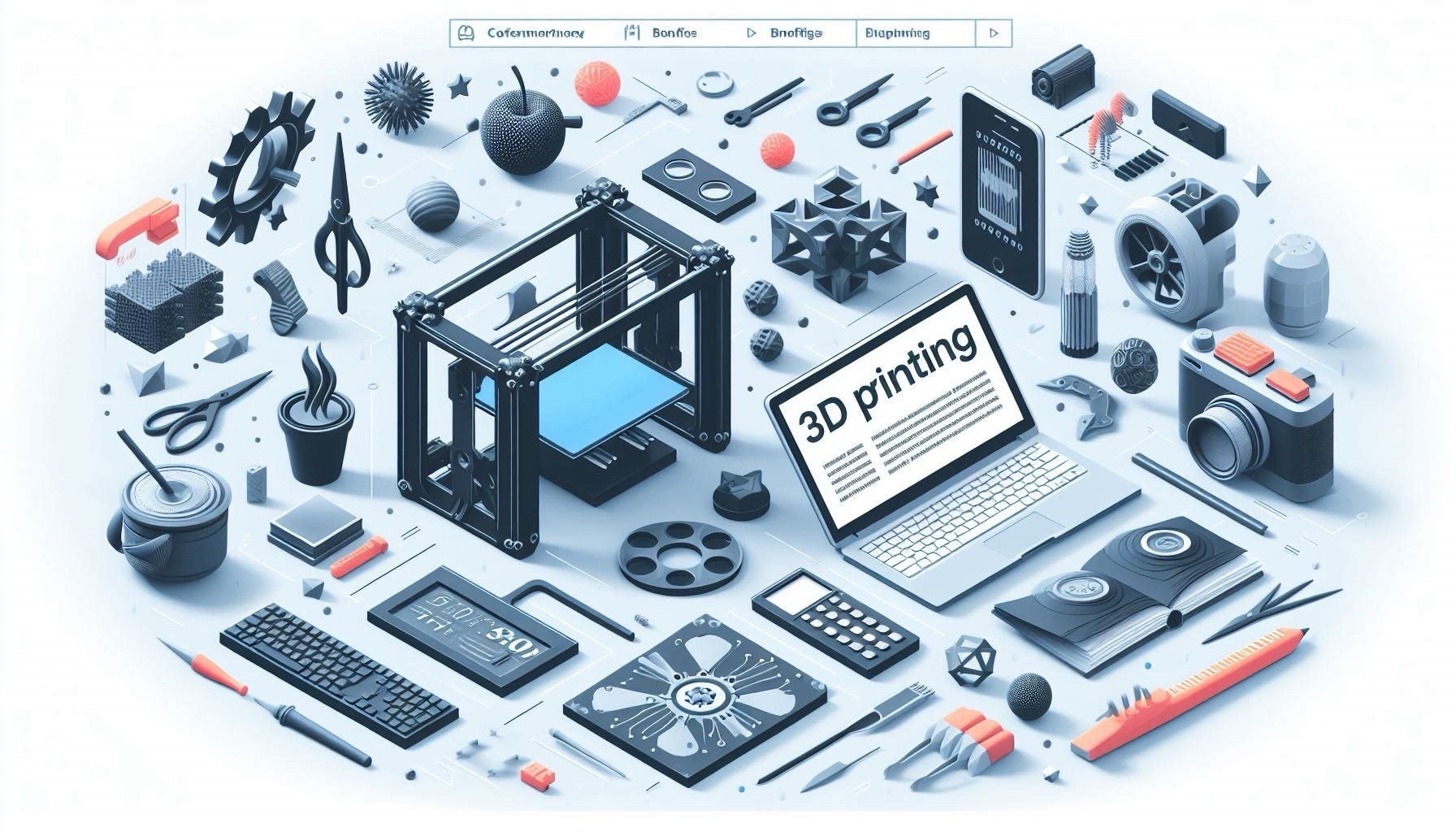
3D Printing: What It Is, How It Works and Why It Matters
3D printing, also known as additive manufacturing, is a process of creating three-dimensional objects from digital models by depositing layers of material on top of each other. Unlike traditional manufacturing methods that cut, drill or carve out parts from a solid block of material, 3D printing builds objects layer by layer, using only the material that is needed. This allows for greater design flexibility, less material waste, lower costs and faster production times.
How Does 3D Printing Work?
The first step in 3D printing is to create a digital model of the object you want to print. You can either design it from scratch using a 3D modeling software, or scan an existing object using a 3D scanner. You can also download ready-made models from online platforms such as Thingiverse or Shapeways.
The next step is to prepare the model for printing. This is done by slicing the model into thin horizontal layers using a software called a slicer. The slicer also generates instructions for the 3D printer on how to move the print head, extrude the material, adjust the temperature and speed, and so on. The sliced model and the instructions are then saved as a file format such as STL, OBJ or G-code.
The final step is to send the file to the 3D printer and start the printing process. Depending on the type of 3D printer and the material used, the printing process can vary. However, the basic principle is the same: the 3D printer heats up the material, usually a plastic filament, resin or powder, and extrudes it through a nozzle onto a build platform, where it solidifies and forms the first layer of the object. The 3D printer then repeats this process for the next layer, and the next, until the object is complete.
What Are the Benefits of 3D Printing?
3D printing has many advantages over traditional manufacturing methods, such as:
- Customization: 3D printing allows you to create unique and personalized objects that suit your needs and preferences. You can modify the shape, size, color, texture and functionality of your objects, or even combine different materials and features. You can also print on demand, which means you only produce what you need, when you need it.
- Complexity: 3D printing enables you to create complex and intricate shapes and structures that would be difficult or impossible to make with conventional methods. You can print hollow parts, internal cavities, overhangs, undercuts, lattice structures and more, without the need for additional tools or supports.
- Efficiency: 3D printing reduces the amount of material and energy required to make an object, as well as the time and labor involved. You can print multiple parts in one go, or print parts that are ready to use without the need for assembly or finishing. You can also print locally, which reduces the transportation and storage costs and the environmental impact.
- Innovation: 3D printing opens up new possibilities for creativity and experimentation. You can test and prototype your ideas quickly and cheaply, or explore new applications and solutions for various fields and industries. You can also collaborate and share your designs with other makers and users around the world.
What Are the Applications of 3D Printing?
3D printing has a wide range of applications across different sectors and domains, such as:
- Education: 3D printing can be used as a tool for learning and teaching, as it helps students to visualize and understand abstract concepts, develop spatial and critical thinking skills, and enhance their creativity and problem-solving abilities. Teachers can also use 3D printing to create engaging and interactive learning materials, such as models, simulations, games and experiments.
- Healthcare: 3D printing can be used to create medical devices and products, such as prosthetics, implants, surgical tools, braces, splints, casts and more. These can be customized to fit the patient’s anatomy, condition and needs, improving their comfort, functionality and quality of life. 3D printing can also be used to create bioprinted tissues and organs, which could potentially revolutionize the field of regenerative medicine and organ transplantation.
- Art and Design: 3D printing can be used to create artistic and aesthetic objects, such as sculptures, jewelry, accessories, clothing, furniture and more. Artists and designers can use 3D printing to express their vision and style, or to experiment with new forms, materials and techniques. 3D printing can also be used to create replicas and reproductions of historical and cultural artifacts, preserving and sharing the heritage and legacy of humanity.
- Engineering and Manufacturing: 3D printing can be used to create functional and durable objects, such as tools, parts, components, machines and more. Engineers and manufacturers can use 3D printing to optimize the performance, efficiency and reliability of their products, or to create new and innovative products that meet the market demands and customer expectations. 3D printing can also be used to create smart and connected objects, such as sensors, actuators, electronics and more, enabling the development of the Internet of Things and Industry 4.0.
What Are the Challenges of 3D Printing?
3D printing is not without its challenges and limitations, such as:
- Quality and Accuracy: 3D printing can produce objects with varying levels of quality and accuracy, depending on the type of 3D printer, the material, the settings and the environment. Some common issues that can affect the quality and accuracy of 3D printed objects are warping, cracking, curling, layering, delamination, shrinkage, distortion and more. These can affect the appearance, strength and functionality of the objects, and may require post-processing or re-printing to fix them.
- Cost and Availability: 3D printing can be expensive and inaccessible, depending on the type of 3D printer, the material, the size and the complexity of the object. Some 3D printers and materials are still costly and rare, and may require special skills and equipment to operate and maintain. Some 3D printers and materials are also limited in their capabilities and compatibility, and may not be able to print certain objects or features. Additionally, some 3D printers and materials may have environmental and health risks, such as emissions, waste, toxicity and more, and may require proper handling and disposal.
- Ethics and Regulations: 3D printing can raise ethical and legal questions and concerns, such as ownership, intellectual property, privacy, security, safety, liability and more. Who owns the rights and responsibilities of the 3D printed objects and the digital models? How can the quality and safety of the 3D printed objects and the materials be ensured and verified? How can the misuse and abuse of the 3D printing technology and the 3D printed objects be prevented and controlled? These are some of the issues that need to be addressed and regulated by the relevant authorities and stakeholders.
Conclusion
3D printing is a revolutionary technology that has the potential to transform the way we create, consume and interact with objects. It offers many benefits and opportunities for various fields and industries, as well as for individuals and communities. However, it also poses some challenges and risks that need to be overcome and managed. As 3D printing becomes more accessible and affordable, it is important to be aware and informed of its capabilities and limitations, as well as its implications and impacts. 3D printing is not just a technology, but a tool for innovation and empowerment, and it is up to us to use it wisely and responsibly.


Leave a Reply to 4D Explained: Unraveling the Fourth Dimension in Simple Terms – FindTekCancel reply