
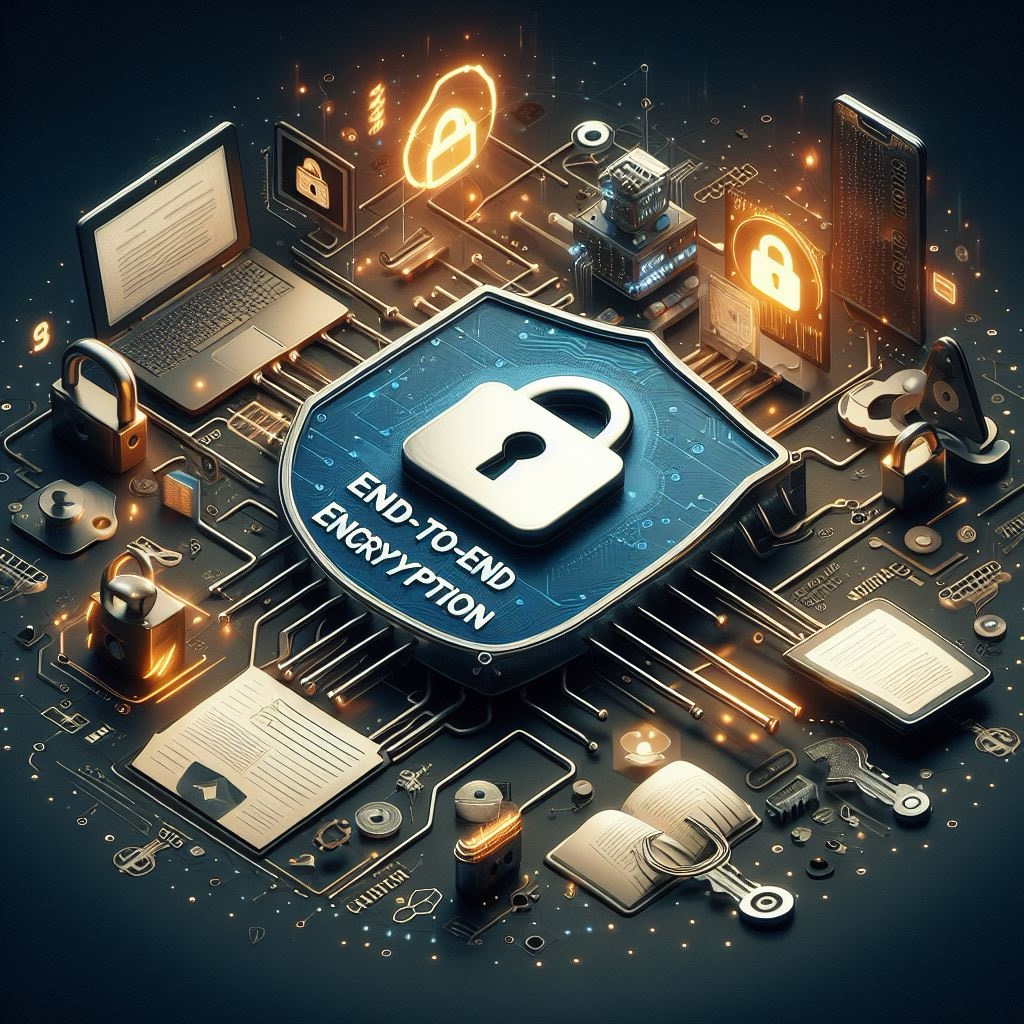
Have you ever wondered how you can communicate online without anyone else snooping on your conversations? How can you send sensitive information such as passwords, credit card numbers, or medical records without worrying about hackers, service providers, or government agencies accessing them? The answer is end-to-end encryption (E2EE), a technology that ensures your data is only readable by you and the intended recipient.
In this blog post, we will explain what end-to-end encryption is, how it works, what are its benefits and challenges, and what are some examples of services that use it. By the end of this post, you will have a better understanding of this important security feature and why you should use it whenever possible.
What is end-to-end encryption?
End-to-end encryption is a method of encrypting data so that only the sender and the receiver can decrypt it. Encryption is the process of transforming data into an unreadable format using a secret key. Decryption is the reverse process of restoring the data to its original form using the same or a different key.
When you use end-to-end encryption, your data is encrypted on your device before it is sent over the internet, and it remains encrypted until it reaches the recipient’s device, where it is decrypted. This means that no one in between, not even the service provider that facilitates the communication, can access or modify your data.
For example, when you send an email using end-to-end encryption, your email is encrypted on your computer or phone using a public key that belongs to the recipient. The encrypted email is then sent to the email server, where it is stored in encrypted form. The recipient can download the encrypted email and decrypt it using their private key, which only they have. The email server, the internet service provider, and anyone else who intercepts the email cannot read or tamper with it.
End-to-end encryption is different from other types of encryption, such as encryption-in-transit or encryption-at-rest. Encryption-in-transit means that the data is encrypted while it is being transferred from one point to another, but it can be decrypted at the endpoints. Encryption-at-rest means that the data is encrypted while it is stored on a device or a server, but it can be decrypted by the owner of the device or the server. These types of encryption provide some level of security, but they also introduce potential vulnerabilities and risks.
Why is end-to-end encryption important?
End-to-end encryption is important because it protects your privacy and security online. By using end-to-end encryption, you can ensure that only you and the person you are communicating with can see the content of your messages, files, or calls. You can also prevent unauthorized access, modification, or deletion of your data by hackers, service providers, or government agencies.
Some of the benefits of end-to-end encryption are:
- It protects your personal and sensitive information from identity theft, fraud, or blackmail.
- It protects your intellectual property, trade secrets, or confidential business documents from industrial espionage or sabotage.
- It protects your human rights, freedom of expression, or political activism from censorship, surveillance, or repression.
- It protects your personal relationships, intimacy, or health from intrusion, harassment, or discrimination.
Some of the challenges of end-to-end encryption are:
- It requires more computational resources and bandwidth than other types of encryption, which can affect the performance and speed of the communication.
- It requires more user awareness and responsibility, such as choosing strong passwords, managing encryption keys, and verifying the identity of the recipients.
- It can make it harder to recover your data if you lose your device, forget your password, or delete your account.
- It can make it harder for law enforcement or emergency services to access your data if you are involved in a crime or a crisis.
What are some examples of end-to-end encryption?
End-to-end encryption is used by many applications and services that require secure communication, such as messaging, email, cloud storage, video conferencing, and online banking. Here are some examples of services that use end-to-end encryption:
- Signal: Signal is a free and open-source messaging and calling app that uses end-to-end encryption for all its features, including text, voice, video, group chat, and file sharing. Signal also offers advanced security options, such as disappearing messages, screen lock, and incognito keyboard. Signal is widely regarded as one of the most secure and privacy-friendly apps available.
- WhatsApp: WhatsApp is a popular messaging and calling app that uses end-to-end encryption for all its features, including text, voice, video, group chat, and file sharing. WhatsApp also offers some security options, such as two-step verification, fingerprint lock, and message forwarding limit. WhatsApp is owned by Meta Platforms, formerly known as Facebook, which has raised some concerns about its privacy practices.
- ProtonMail: ProtonMail is a secure and private email service that uses end-to-end encryption for all its features, including email, contacts, and calendar. ProtonMail also offers some security options, such as self-destructing messages, password-protected messages, and anonymous accounts. ProtonMail is based in Switzerland, which has strong data protection laws.
- NordLocker: NordLocker is a secure and easy-to-use cloud storage service that uses end-to-end encryption for all its features, including file upload, download, and sharing. NordLocker also offers some security options, such as master password, recovery code, and trusted devices. NordLocker is powered by NordPass, a leading password manager that also uses end-to-end encryption.
- Zoom: Zoom is a popular video conferencing and collaboration platform that uses end-to-end encryption for some of its features, including video, audio, chat, and screen sharing. Zoom also offers some security options, such as meeting password, waiting room, and host control. Zoom is widely used by businesses, schools, and individuals for various purposes.
Conclusion
End-to-end encryption is a technology that ensures your data is only readable by you and the intended recipient. It protects your privacy and security online by preventing anyone else from accessing or modifying your data. It is used by many applications and services that require secure communication, such as messaging, email, cloud storage, video conferencing, and online banking. You should use end-to-end encryption whenever possible to safeguard your personal and sensitive information.


Leave a Reply to System on Chip (SoC): Explained Simply – FindTekCancel reply