
Apple Vision Pro vs Meta Quest 3: Which Mixed Reality Headset Should You Buy?
Apple and Meta (formerly Facebook) are two of the biggest tech giants in the world, and they are both competing for the future of mixed reality. Apple recently launched its Vision Pro headset, a premium device that promises to deliver immersive and interactive experiences in both augmented reality (AR) and virtual reality (VR). Meta, on the other hand, has been in the VR game for a while, and its latest product, the Quest 3, is a powerful and affordable headset that also supports AR features.
But which headset is better for you? How do they compare in terms of price, design, performance, features, and content? In this blog post, we will try to answer these questions and help you decide which mixed reality headset to buy.
Price
The price difference between the two headsets is huge. The Apple Vision Pro costs $3,499 for the 256GB model, $3699 for the 512 GB, $3899 for the 1TB model, making it one of the most expensive consumer devices ever. That price does not include accessories, such as the custom Zeiss optical inserts.
The Meta Quest 3, on the other hand, is much more affordable. It starts at $499.99 for the 128GB model, and $649.99 for the 512GB model. You can buy it online or in retail stores, and you don’t need any extra accessories to use it.
If you are on a tight budget, or you are not sure if you want to invest in mixed reality, the Quest 3 is a clear winner. However, if you are willing to pay a premium for a more advanced and sophisticated device, the Vision Pro may be worth considering.
Design and Comfort
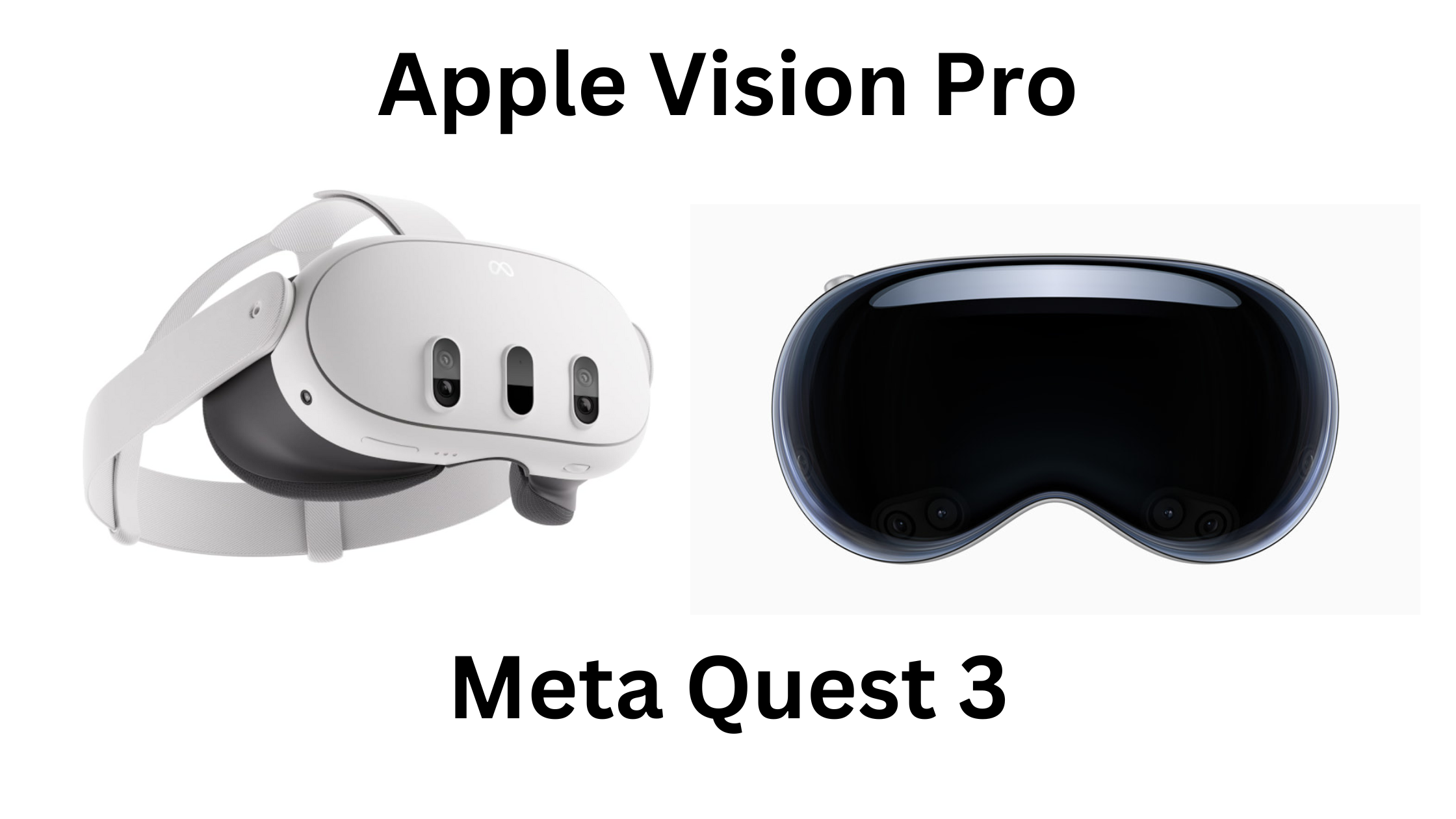
The Apple Vision Pro and the Meta Quest 3 have very different designs and aesthetics. The Vision Pro is heavy but futuristic, with a white and silver color scheme and a curved visor. It has 12 cameras, 6 microphones, and 5 sensors on the front, and a dial on the side that lets you adjust the level of immersion. It weighs about 600–650 grams (Separate battery weighs 353g), which is relatively heavier for a mixed reality headset( heavier than most VR headsets).

The Meta Quest 3 is more lightweight (Compared to vision Pro) and angular, with a black and gray color scheme and a rectangular visor. It has two RGB cameras and a depth projector on the front. It weighs 515 grams, which is slightly lighter than the Vision Pro.

Both headsets have adjustable straps that let you fit them to your head size and shape. The Vision Pro also has eye tracking. The Quest 3 does not have eye tracking.
In terms of comfort, both headsets have their pros and cons. The Vision Pro is heavier and it may also be more prone to overheating and battery drain. The Quest 3 is lighter and more rigid, but it may also be more durable and stable. Ultimately, comfort is a subjective and personal factor, and it may depend on your preferences and usage habits.
Performance and Features
The Apple Vision Pro and the Meta Quest 3 are both powerful and feature-rich devices, but they have different strengths and weaknesses. The Vision Pro has two chips inside: the M2 chip, which is similar to the one in the latest MacBook Pro, and the R1 chip, which is a custom chip designed for mixed reality. The Quest 3 has one chip: the Qualcomm Snapdragon XR2 Gen 2, which is an upgraded version of the one in the Quest 2.
The Vision Pro has a higher display resolution than the Quest 3, with 4K per eye, compared to 4K+ Infinite Display (2 LCDs with 2064 x 2208 pixels per eye) for the Quest 3. However, the Quest 3 has a higher refresh rate than the Vision Pro, with 120Hz, compared to 90Hz for the Vision Pro. The higher the refresh rate, the smoother and more realistic the motion and animation.
The Vision Pro also has more cameras and sensors than the Quest 3, which enables more accurate and responsive tracking of your head, hands,eye and environment. The Vision Pro supports both hand tracking and eye tracking, while the Quest 3 only supports controller tracking. The Vision Pro also has face tracking, which allows you to see and interact with your own facial expressions and emotions in mixed reality.
The Quest 3, however, has a better color passthrough than the Vision Pro, which means that the AR mode looks more natural and vibrant. The Quest 3 also has a depth projector, which allows it to create a 3D map of your surroundings and enable occlusion, which means that virtual objects can appear behind or in front of real objects.
Both headsets have built-in speakers and microphones, which allow you to hear and communicate in mixed reality. The Vision Pro also has spatial audio, which creates a more immersive and realistic sound experience. The Quest 3 does not have spatial audio, but it has a 3.5mm audio jack, which allows you to connect your own headphones or earbuds.
Both headsets have a battery life of about 2 hours, which is not very impressive for a mixed reality device. However, the Vision Pro comes with an external battery pack, which extends the battery life. The Quest 3 does not have an external battery pack, but it has a USB-C port, which allows you to charge it while using it.
Content and Apps
The Apple Vision Pro and the Meta Quest 3 have different content and app ecosystems, which may affect your choice of headset. The Vision Pro runs on a new operating system called visionOS, which is based on iPadOS. The Quest 3 runs on a modified version of Android, which is compatible with most VR apps and games.
The Vision Pro has access to the App Store, which is the largest and most popular app store in the world. However, not all iPadOS apps are compatible with the Vision Pro, and some may require optimization or adaptation. The Quest 3 has access to the Meta Store, which is a dedicated app store for VR and AR content. However, the Meta Store is smaller and more curated than the App Store, and some apps may be exclusive or restricted.
The Vision Pro also has access to Apple’s own apps and services, such as Safari, Apple Music, Apple TV, Apple Arcade, and more. These apps are designed to work seamlessly with the Vision Pro and offer a high-quality and consistent experience. The Quest 3 also has access to Meta’s own apps and services, such as Horizon, Venues, Workrooms, and more. These apps are designed to leverage the social and collaborative aspects of mixed reality and offer a fun and engaging experience.
Both headsets have a variety of content and apps to choose from, but they cater to different audiences and preferences. The Vision Pro may appeal more to users who want a premium and polished experience, and who are already invested in the Apple ecosystem. The Quest 3 may appeal more to users who want a more affordable and accessible experience, and who are more interested in gaming and socializing.
Conclusion
The Apple Vision Pro and the Meta Quest 3 are both impressive and innovative devices, but they are not for everyone. The Vision Pro is a high-end and high-priced headset, that offers a more advanced and sophisticated mixed reality experience. The Quest 3 is a mid-range and low-priced headset, that offers a more powerful and immersive VR gaming experience.
The best headset for you depends on your budget, your needs, your expectations, and your preferences. If you are looking for a device that can do it all, and you don’t mind paying a premium, the Vision Pro may be the right choice for you. If you are looking for a device that can deliver a great VR experience, and you want to save some money, the Quest 3 may be the right choice for you.
Ultimately, the choice is yours. But whichever headset you choose, you can be sure that you are entering a new and exciting world of mixed reality.


Leave a Reply