
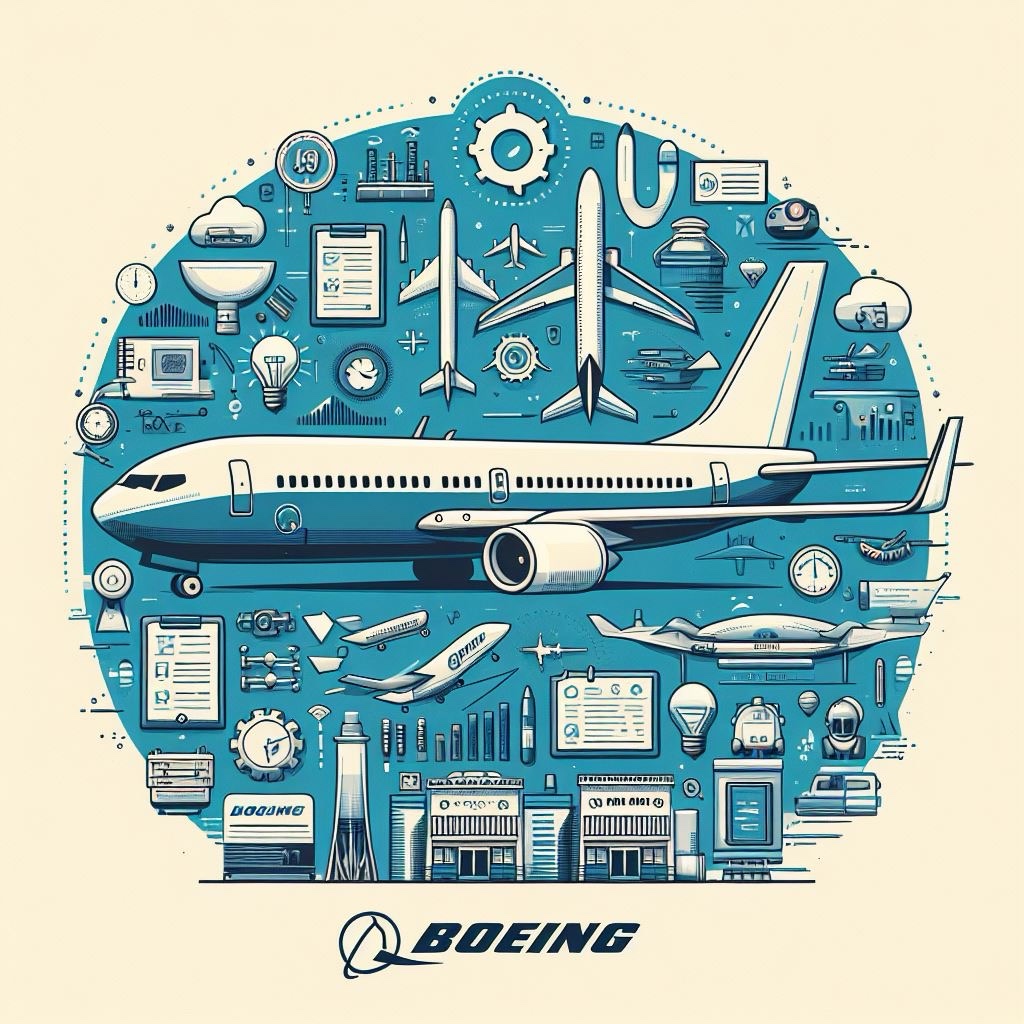
Boeing: The World’s Largest Aerospace Company
Boeing is an American multinational corporation that designs, manufactures, and sells airplanes, rotorcraft, rockets, satellites, telecommunications equipment, and missiles worldwide. In this blog, we will explore the history, products, and achievements of Boeing, as well as some of the challenges and opportunities it faces in the 21st century.
The History of Boeing
Boeing was founded by William E. Boeing, a lumber industrialist, in Seattle, Washington, on July 15, 1916. He named his company Pacific Aero Products Co. and started building seaplanes and trainers for the US Navy during World War I. A year later, he renamed his company Boeing Airplane Company and expanded his operations to include mail delivery, passenger transport, and aircraft design and testing. Boeing also acquired several other aviation companies, such as Pratt & Whitney, Sikorsky, and Stearman, to diversify its portfolio and increase its market share.
During World War II, Boeing produced thousands of military aircraft, such as the B-17 Flying Fortress, the B-29 Superfortress, and the P-51 Mustang, which played a crucial role in the Allied victory. After the war, Boeing entered the commercial aviation market with the introduction of the 707, the first successful jet airliner, in 1958. Boeing also ventured into the space industry with the development of the Saturn V rocket, which powered the Apollo missions to the moon, and the Space Shuttle, which carried astronauts and cargo to the International Space Station.
In 1997, Boeing merged with McDonnell Douglas, another major aerospace company, to form the present-day Boeing Company. The merger gave Boeing access to new markets and technologies, such as fighter jets, helicopters, and missiles. Boeing also continued to innovate and dominate the commercial aviation sector with the launch of new models, such as the 737, the 747, the 777, and the 787, which are among the most popular and best-selling aircraft in the world.


The Products and Services of Boeing
Boeing is organized into four primary divisions: Boeing Commercial Airplanes (BCA), Boeing Defense, Space & Security (BDS), Boeing Global Services, and Boeing Capital. Each division offers a range of products and services to meet the needs and demands of various customers and markets.
- Boeing Commercial Airplanes (BCA) is the largest division of Boeing and the leader in the global commercial aviation industry. BCA produces and sells passenger and cargo aircraft, such as the 737, the 747, the 767, the 777, and the 787, as well as freighters, business jets, and regional jets. BCA also provides technical support, maintenance, and training to airlines and operators around the world.
- Boeing Defense, Space & Security (BDS) is the second-largest division of Boeing and the third-largest defense contractor in the world. BDS provides products and services for military and government customers, such as fighter jets, bombers, helicopters, tankers, transports, satellites, rockets, missiles, drones, and cybersecurity solutions. BDS also participates in major defense and space programs, such as the F/A-18 Super Hornet, the KC-46 Pegasus, the P-8 Poseidon, the CST-100 Starliner, and the Space Launch System.
- Boeing Global Services is the newest division of Boeing, created in 2016 to integrate the services capabilities of BCA and BDS. Boeing Global Services offers a wide range of solutions for commercial and government customers, such as parts, engineering, modifications, digital, analytics, supply chain, training, and logistics. Boeing Global Services aims to enhance the performance, efficiency, and safety of Boeing products and services throughout their life cycle.
- Boeing Capital is the financial arm of Boeing, which provides financing and leasing solutions for Boeing customers and partners. Boeing Capital offers various products, such as loans, leases, guarantees, and asset management, to facilitate the acquisition and operation of Boeing products and services. Boeing Capital also manages and sells Boeing’s portfolio of aircraft, engines, and other assets.
The Achievements and Challenges of Boeing
Boeing is one of the most successful and influential companies in the history of aviation and aerospace. It has achieved many milestones and records, such as:
- Building the first jet airliner, the 707, which revolutionized air travel and commerce.
- Developing the first jumbo jet, the 747, which opened up new routes and markets for long-haul flights.
- Creating the first reusable spacecraft, the Space Shuttle, which enabled human exploration and research in low Earth orbit.
- Producing the most popular and best-selling aircraft, the 737, which has delivered more than 10,000 units and flown more than 200 billion passengers.
- Launching the most advanced and fuel-efficient aircraft, the 787, which uses composite materials and electric systems to reduce weight and emissions.
However, Boeing also faces many challenges and difficulties, such as:
- Competing with rival companies, such as Airbus, Lockheed Martin, and SpaceX, which offer similar or superior products and services.
- Dealing with technical issues, accidents, and scandals, such as the 737 MAX crashes, the 787 battery fires, and the KC-46 delivery delays, which have damaged Boeing’s reputation and profitability.
- Adapting to changing customer preferences, market conditions, and environmental regulations, which require Boeing to innovate and improve its products and services.
- Coping with the impact of the COVID-19 pandemic, which has caused a sharp decline in air travel and demand for aircraft, resulting in massive losses and layoffs for Boeing.
The Opportunities and Future of Boeing
Despite the challenges and difficulties, Boeing also has many opportunities and prospects for the future, such as:
- Expanding its presence and partnerships in emerging markets, such as China, India, and Southeast Asia, which have huge potential for growth and development in the aviation and aerospace sectors.
- Exploring new domains and frontiers, such as hypersonic flight, urban air mobility, and deep space exploration, which offer exciting possibilities and challenges for Boeing.
- Leveraging its digital and data capabilities, such as artificial intelligence, machine learning, and blockchain, which can enhance Boeing’s products and services and create new value for customers and stakeholders.
- Embracing its social and environmental responsibilities, such as reducing its carbon footprint, increasing its diversity and inclusion, and supporting its communities and causes, which can improve Boeing’s image and impact.
Boeing is a remarkable company that has shaped and transformed the world of aviation and aerospace for over a century. It has a rich history, a diverse portfolio, and a bright future. Boeing is not only a company, but also a culture, a vision, and a legacy.


Leave a Reply