
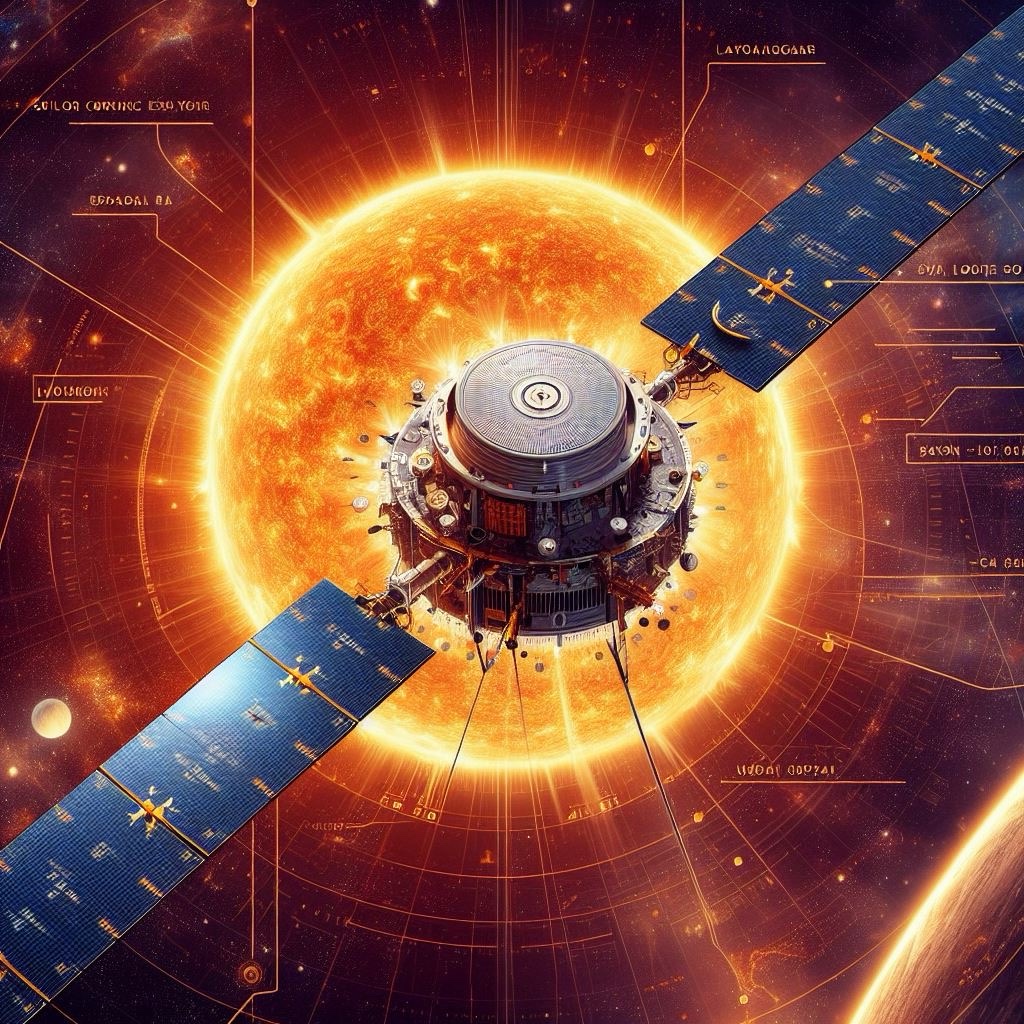
India has achieved yet another milestone in its space exploration with the successful launch and orbit insertion of Aditya-L1, the country’s first mission dedicated to study the Sun. Aditya-L1 is a solar observatory that will observe the Sun from a unique vantage point, the Lagrange Point 1 (L1), where the gravitational effects of the Earth and the Sun balance each other. This will enable the spacecraft to continuously view the Sun without any interruptions or eclipses.
Aditya-L1 was launched on September 2, 2023, by the Indian Space Research Organisation (ISRO) using the Polar Satellite Launch Vehicle (PSLV) from the Satish Dhawan Space Centre in Sriharikota. After a series of orbit-raising maneuvers, the spacecraft reached the L1 point on January 6, 2024, and entered a halo orbit around it. This was a challenging and critical maneuver, as it involved firing the thrusters to change the speed and trajectory of the spacecraft. ISRO successfully performed this maneuver and placed Aditya-L1 in its final destination orbit.
The main objectives of Aditya-L1 are to study the dynamics of the Sun’s atmosphere, including the chromosphere and corona, the origin and evolution of solar flares and coronal mass ejections, the magnetic field and heating mechanisms of the corona, and the impact of solar activity on the Earth’s environment and climate. To achieve these objectives, Aditya-L1 carries seven scientific payloads, four of which directly look at the Sun, while the other three measure the particles and magnetic fields in the vicinity of the spacecraft.
Some of the unique features and benefits of Aditya-L1 are:
- It will provide the first spatially resolved images of the Sun in the near ultraviolet band, which will reveal the intricate details of the solar atmosphere and its drivers.
- It will measure the soft and hard X-ray emissions from the Sun, which will help understand the processes of coronal heating and particle acceleration.
- It will observe the corona in visible light using a coronagraph, which will block the bright disk of the Sun and reveal the faint structures of the corona. This will help study the origin and dynamics of coronal mass ejections, which are large eruptions of plasma and magnetic fields from the Sun that can affect the Earth’s magnetosphere and satellites.
- It will monitor the solar wind, which is the constant stream of charged particles from the Sun that fills the interplanetary space. This will help understand the origin, composition, and variability of the solar wind and its interaction with the Earth’s environment.
- It will measure the in-situ magnetic field of the Sun-Earth system, which will provide valuable information on the topology and dynamics of the coronal magnetic field and its influence on the space weather.
Aditya-L1 is expected to operate for at least five years, during which it will provide unprecedented data and insights into the Sun and its effects on the Earth. Aditya-L1 is a landmark mission for India, as it showcases the country’s rising role and capabilities in space research and exploration. Aditya-L1 will also contribute to the global scientific community and enhance our understanding of the Sun, which is the source of life and energy for our planet. Aditya-L1 is a shining example of India’s vision and ambition in space.


Leave a Reply