
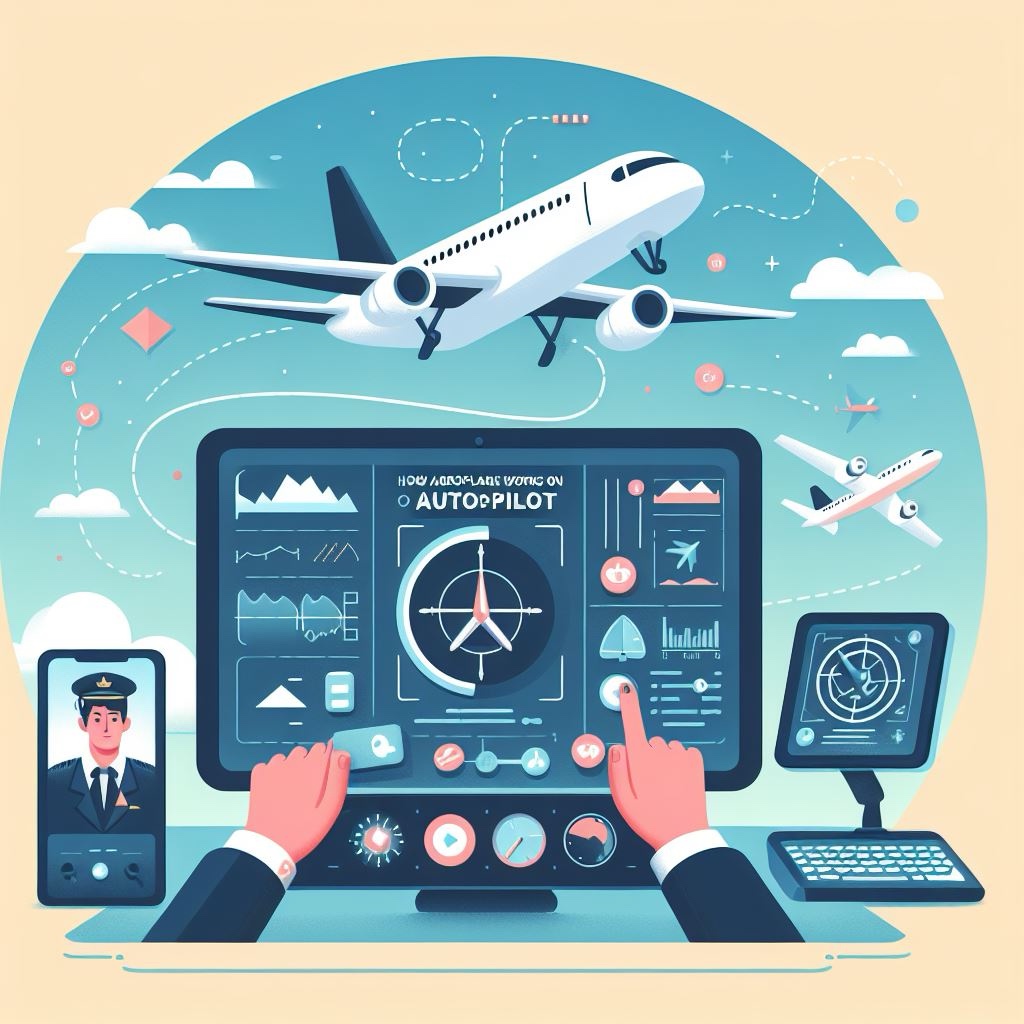
Have you ever wondered how aeroplanes can fly without human intervention? How do they know where to go, how fast to fly, and when to land? The answer is autopilot, a system that controls an aircraft without direct assistance from the pilot. In this blog post, we will explore how autopilot works, what are its advantages and limitations, and how it affects the role of the pilot.
What is autopilot?
Autopilot is a collection of technologies that enable an aircraft to fly on a predetermined course, maintain a constant altitude and speed, and perform other functions such as navigation, communication, and landing. Autopilot can be used to reduce the workload and fatigue of the pilot, especially during long and routine flights. Autopilot can also improve the safety and efficiency of the flight, as it can react faster and more accurately to changing conditions and avoid human errors.
How does autopilot work?
Autopilot consists of four main components: sensors, computer, output, and command.
- Sensors are devices that measure the motion, position, and environment of the aircraft, such as gyroscopes, accelerometers, altimeters, airspeed indicators, GPS, and radio receivers. Sensors provide feedback to the computer about the actual state of the aircraft and the external factors that affect it.
- Computer is the brain of the autopilot system, which processes the data from the sensors and compares it with the desired state of the aircraft, such as the heading, altitude, speed, and route. The computer also receives input from the pilot or the flight management system, which sets the goals and parameters for the autopilot. The computer then calculates the necessary corrections or changes to achieve the desired state and sends signals to the output devices.
- Output devices are servomotors that actuate the engines and the control surfaces of the aircraft, such as the elevators, rudder, and ailerons. Output devices execute the commands from the computer and adjust the thrust, pitch, roll, and yaw of the aircraft accordingly.
- Command devices are switches and knobs that allow the pilot to activate, deactivate, or modify the autopilot system. Command devices also display the status and mode of the autopilot system to the pilot.
Autopilot can operate in different modes, depending on the level of automation and the function required. For example, some common modes are:
- Heading hold: The autopilot maintains a constant magnetic heading, using the rudder and ailerons to counteract any deviation caused by wind or turbulence.
- Altitude hold: The autopilot maintains a constant altitude, using the elevators and the throttle to counteract any deviation caused by changes in air density or speed.
- Speed hold: The autopilot maintains a constant speed, using the throttle and the pitch to counteract any deviation caused by changes in wind or drag.
- Vertical speed hold: The autopilot maintains a constant rate of climb or descent, using the elevators and the throttle to adjust the pitch and the power.
- Approach: The autopilot follows a predefined path to the runway, using the radio signals from the instrument landing system (ILS) or the satellite-based navigation system (GNSS) to guide the aircraft. The autopilot can also control the flaps, landing gear, and spoilers to prepare the aircraft for landing.
- Autothrottle: The autopilot controls the engine power to maintain a desired speed or thrust setting, regardless of the changes in weight, drag, or altitude.

What are the advantages and limitations of autopilot?
Autopilot has many benefits for both the pilot and the passengers, such as:
- Convenience: Autopilot allows the pilot to focus on other aspects of the flight, such as monitoring the systems, communicating with the air traffic control, and planning the next phase of the flight. Autopilot also reduces the physical and mental stress of the pilot, especially during long and monotonous flights.
- Safety: Autopilot can prevent or correct human errors, such as fatigue, distraction, or miscalculation. Autopilot can also handle complex or emergency situations, such as bad weather, traffic avoidance, or system failure, better than a human pilot. Autopilot can also reduce the risk of spatial disorientation, which is a condition where the pilot loses the sense of direction and orientation due to the lack of visual cues or conflicting sensory inputs.
- Efficiency: Autopilot can optimize the flight performance and fuel consumption of the aircraft, by adjusting the speed, altitude, and route according to the weather, traffic, and terrain conditions. Autopilot can also coordinate with the air traffic control and other aircraft to reduce the congestion and delays in the airspace.
However, autopilot also has some limitations and challenges, such as:
- Reliability: Autopilot depends on the accuracy and availability of the sensors, computer, and output devices. If any of these components malfunction or fail, the autopilot system may not work properly or at all. Therefore, the pilot must always monitor the autopilot system and be ready to take over the control manually if needed.
- Complexity: Autopilot is a sophisticated and dynamic system that requires a lot of knowledge and skill to operate and understand. The pilot must be familiar with the functions, modes, and logic of the autopilot system, and be able to interpret the feedback and alerts from the system. The pilot must also be able to switch between different modes and levels of automation, and coordinate with the autopilot system effectively and efficiently.
- Complacency: Autopilot can create a false sense of security and confidence for the pilot, who may become over-reliant on the system and lose the situational awareness and the manual skills. The pilot may also become bored or distracted by the lack of active involvement in the flight, and lose the attention and motivation to monitor the autopilot system and the environment. This can lead to a loss of control or a delayed response in case of an unexpected event or a system failure.
How does autopilot affect the role of the pilot?
Autopilot does not replace the pilot, but rather assists the pilot in controlling the aircraft. The pilot is still responsible for the safety and the outcome of the flight, and must always supervise and intervene with the autopilot system when necessary. The pilot must also maintain the proficiency and the readiness to fly the aircraft manually, in case of an emergency or a system failure. Therefore, the role of the pilot is not diminished, but rather transformed by the autopilot system. The pilot must adapt to the changing technology and environment, and develop the skills and the mindset to work with the autopilot system effectively and safely.
Conclusion
Autopilot is a system that controls an aircraft without direct assistance from the pilot. It works by using sensors, computer, output, and command devices to measure, compare, and adjust the state of the aircraft according to the desired goals and parameters. Autopilot has many advantages and limitations, and it affects the role of the pilot in various ways. Autopilot is not a substitute, but a supplement for the pilot, who must always be in charge and in control of the flight.


Leave a Reply